Use class
-
31
-
32
-
33
-
34
-
41–43
A plain-language guide to specifying commercial and contract LVT — the seven things that turn a residential-looking vinyl tile into a compliant contract specification: use class, wear layer, fire class, slip, format, installation method and documentation.
Written for contractors, developers, architects and interior designers who need an LVT floor to survive both heavy traffic and tender review. Trivaro supplies commercial LVT and luxury vinyl tiles across Europe with full documentation as standard.
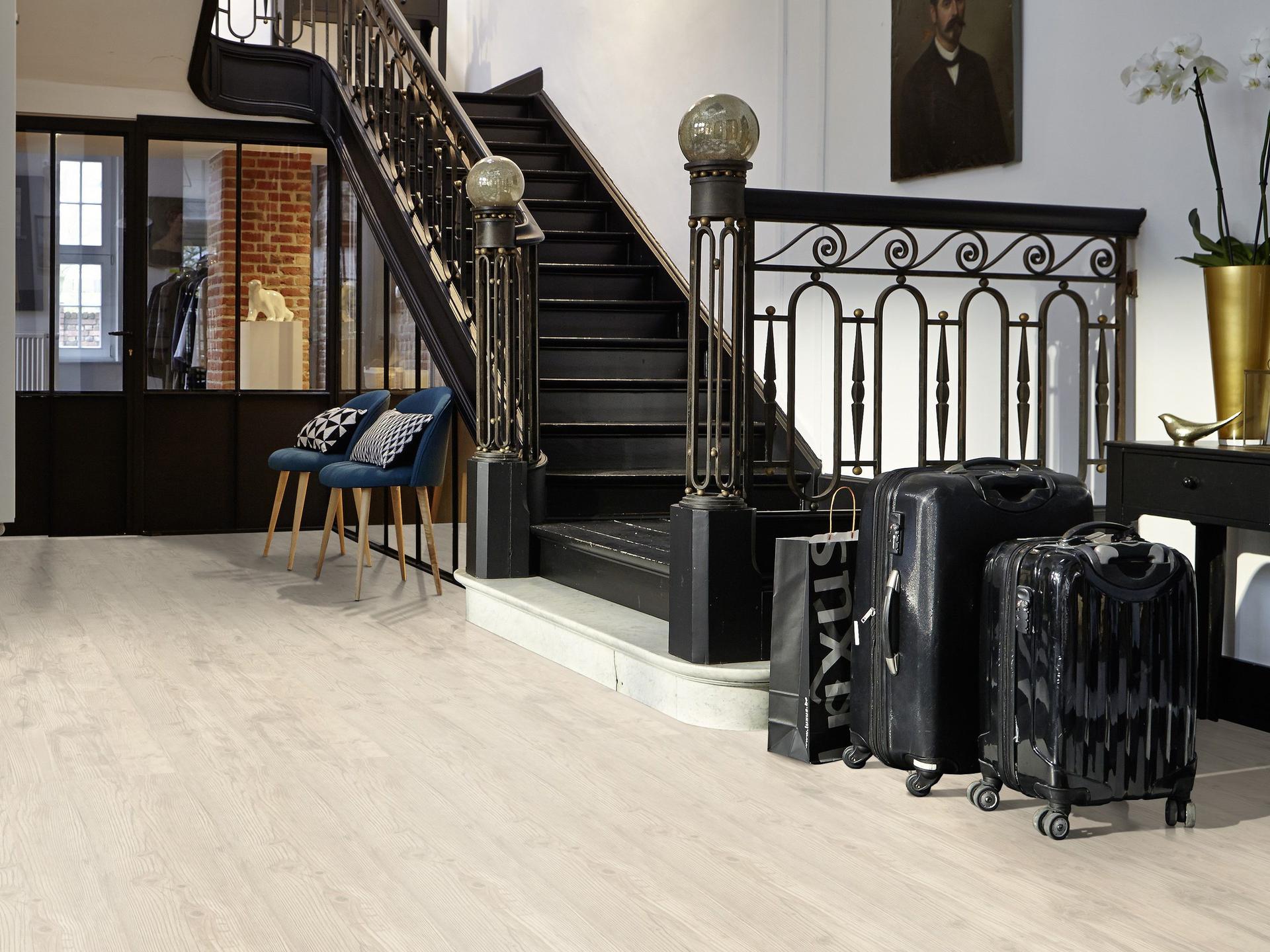
A complete commercial LVT specification defines seven things. Get these on the drawing and the tender, and the floor that arrives is the floor you designed.
Tile/plank size; herringbone, chevron, mixed-width or modular layout.
0.55 mm+ for heavy commercial; 0.3–0.4 mm light commercial only.
EN ISO 10874 class 33–34; selected lines 41–43.
Bfl-s1 under EN 13501-1 — verified by DoP.
R9–R10 general; R11–R12 safety vinyl for wet zones.
Glue-down for traffic/rolling loads; click for fast refurb.
Impact-sound (dB) target — underlay or acoustic LVT build.
Datasheet, DoP, fire & slip reports, EPD on request.
Both are LVT. For commercial projects the choice comes down to traffic, rolling loads and how fast the space must turn around — and glue-down wins most heavy-traffic briefs.
Use class is the single most misread figure on an LVT datasheet. The first digit is the area type (2 = domestic, 3 = commercial, 4 = industrial); the second digit is the intensity (1 = moderate to 4 = very heavy). Specify the class that matches the real traffic of each zone.
31
32
33
34
41–43
Moderate commercial
General commercial
Heavy commercial
Very heavy commercial
Light industrial
Hotel rooms, small offices
Offices, classrooms, boutiques
Open-plan offices, retail, healthcare
Airports, large retail, busy corridors
Light production, workshops
0.30 mm
0.40 mm
0.55 mm
0.55–0.70 mm
0.70 mm+
From a blank specification clause to a tender-ready package. Four steps that prevent the most common contract disputes — wrong use class, thin wear layer, missing fire or slip data.
Start with the non-negotiables: EN ISO 10874 use class per zone, wear-layer minimum (0.55 mm for heavy traffic), reaction-to-fire class (Bfl-s1) and the slip rating each space needs. These are the clauses a building-control reviewer checks.
Tile or plank size and layout — herringbone, chevron, mixed-width or modular — plus the décor and surface texture. Zone wood and stone tones to guide flows without physical dividers.
Glue-down for traffic and rolling loads, click for fast refurb. Require a moisture test (RH or CM%), a flatness tolerance and the correct adhesive open time — skipped subfloor prep is the leading cause of LVT failure.
Require the datasheet, DoP with fire and use class, fire and slip test reports and — where relevant — EPD and low-VOC certificates at handover. Trivaro provides draft specification text and quantity take-offs to drop straight into the tender.
A floor that performs but cannot prove it will fail a tender or a building-control review. This is the package a serious commercial LVT supplier provides.
Format, total thickness, wear layer, use class, fire class, slip rating and installation requirements in one document.
The CE/UKCA document stating the reaction-to-fire class (EN 13501-1) and declared characteristics — the proof behind the spec.
The underlying EN 13501-1 / EN ISO 9239-1 test report from an accredited laboratory backing the declared Bfl-s1 class.
DIN 51130 (R-value) and/or pendulum (PTV) data — essential for entrances, healthcare and wet zones.
Lifecycle environmental data and indoor-air labels for green-building credits and ESG reporting. On request for many lines.
Draft clause wording and quantity take-offs to drop into tender documents — provided by Trivaro to support the bid.
Continue with the product range and the LVT vs SPC comparison for the full picture of commercial vinyl tile.
Commercial LVT Flooring — luxury vinyl tiles for offices, retail, healthcare and hospitality across Europe.
LVT vs SPC flooring — flexible LVT or rigid-core SPC? Cores, stability and installation compared.
Marine flooring — IMO/MED certified marine vinyl and LVT for vessels and superyachts.
The questions we hear most often from contractors, developers and architects writing an LVT specification. See also the LVT range.
Commercial LVT is specified by performance class, not just appearance: a 0.55 mm+ wear layer, a higher EN ISO 10874 use class (33–34, selected 41–43), a verified Bfl-s1 reaction-to-fire class, a documented slip rating (R9–R11) and a PUR-protected surface. Residential LVT can look identical but uses a 0.2–0.3 mm wear layer and lacks the documentation a contract spec requires.
Specify use class 33 (heavy commercial) or 34 (very heavy commercial); selected lines reach 41–43. Pair that with a 0.55 mm+ wear layer for heavy traffic; 0.3–0.4 mm suits light commercial only. The wear layer is the clear top above the décor film — match the class to the real traffic of each zone, not the whole building.
Most commercial LVT achieves Bfl-s1 under EN 13501-1 (low contribution to fire, low smoke), tested as a floor covering (the ‘fl’ suffix). The exact class depends on building type and escape-route rules in national regulations. The specifier sets it; the supplier proves it with a DoP and fire test report.
Standard commercial LVT is R9–R10 (DIN 51130). For wet or high-risk areas — entrances, healthcare, kitchens, changing rooms — specify a dedicated safety vinyl at R11–R12 with a defined pendulum (PTV) value. Define the slip characteristic per zone, not per building, and require the test data.
Glue-down (dryback) for high-traffic areas, rolling loads and large open spaces — strongest bond and stability for class 33–34. Click (floating) for fast refurbishments, occupied spaces and raised access floors, but not for continuous rolling point loads. See the LVT vs SPC guide for the core comparison.
A technical datasheet, a DoP/DoC with fire and use class, the fire and slip test reports, and on request an EPD and low-VOC indoor-air certificate. For tenders, also specification text and quantity take-offs. Trivaro supplies the datasheet, DoP, fire and slip reports as standard, with EPD and indoor-air certificates on request.
Define seven things: format and pattern; wear-layer thickness; use class; reaction-to-fire class; slip rating per zone; installation method and adhesive; and the documentation package required at handover. Add subfloor moisture limits and acoustic targets. Trivaro can provide draft specification text and take-offs for your tender.
Beyond the explainer — Trivaro is a B2B supplier of commercial LVT and luxury vinyl tiles for distributors, contractors, developers and architects across Europe. Glue-down and click systems with full documentation included as standard.
Send us your project type, area estimate, required use class and target fire and slip ratings. We will respond with specification text, product recommendations, samples and a B2B quotation.